

Forward Chaining vs. Backward Chaining in AI
Artificial Intelligence (AI) continues to play a crucial role in modern technology, especially in decision-making systems. These methods will help machines think logically, reach conclusions, and solve complex problems.
Understanding how these techniques work can provide a deeper insight into AI systems like chatbots, virtual assistants, and expert systems.
What is Forward Chaining?
It is a data-driven reasoning method that begins with known facts and applies inference rules to extract more data until a goal is achieved. It is commonly used in rule-based systems where a chain of events must be followed.
For instance, in a healthcare system, if a patient has a fever and a sore throat, forward chaining can be used to conclude a possible infection. The system processes input symptoms step-by-step and moves forward to the conclusion.
This method often relies on conditional statements:
If condition A is true, then perform action B.
What is Backward Chaining?
Backward chaining is goal-driven. It starts with the goal and works backward to verify if facts support that goal. This method is often applied in diagnostic and decision-making systems.
For example, if the goal is to determine whether a server is down, backward chaining will first check whether the system is unreachable, if there’s no power, and then if the network cable is unplugged. Each condition is verified to confirm the conclusion.
It often uses modal verbs like could, might, or must:
If the server is off, it could be due to power failure.
Forward and Backward Chaining: A Logical Comparison
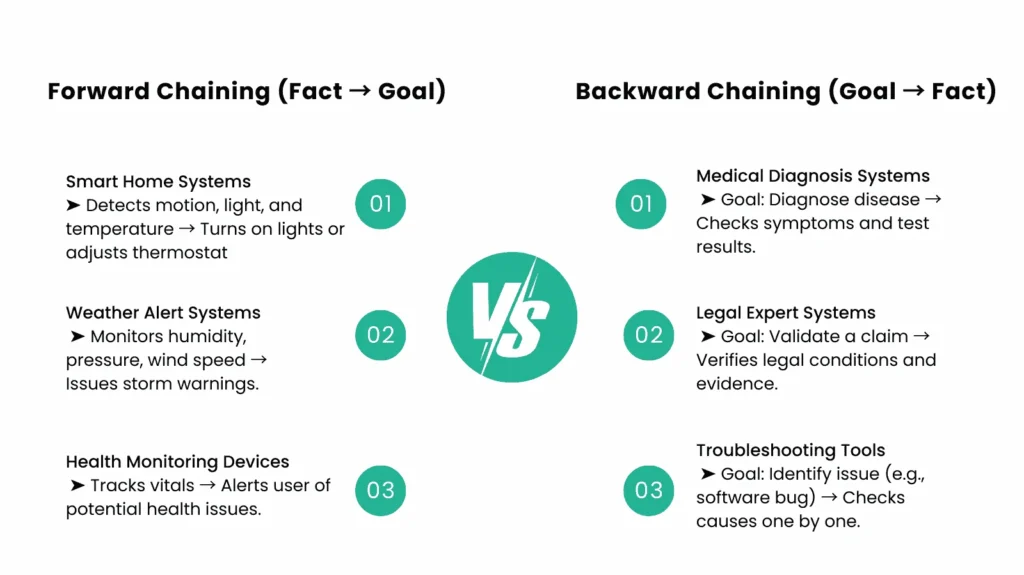
Let’s compare both that is based on how they work in different scenarios.
Examples
Below are some examples that simplify how they function:
| Application Area | Forward Chaining | Backward Chaining |
|---|---|---|
| Healthcare AI | From symptoms to diagnosis | From diagnosis to check symptoms |
| Customer Support Bot | From user query to solution | From solution to trace issue |
| Education AI Tool | Builds knowledge from known facts | Checks prerequisites for achieving a goal |
Understanding Forward Reasoning
Forward reasoning is the driving force behind forward chaining. It refers to the logical process of drawing conclusions from available facts and moving ahead to reach the final answer. It works efficiently in dynamic environments where inputs constantly change.
Forward reasoning:
Adds new facts as they are discovered
Applies known rules to generate conclusions
Continues until a final result is obtained
It is used in:
Expert systems
Chatbots
Robotic control systems
Smart assistants
When to Use Forward or Backward Chaining
Choosing between these depends on the problem:
Use forward chaining when all facts are available but the goal is unknown.
Use backward chaining when the goal is defined but supporting facts must be verified.
For example:
A weather system uses forward chaining to determine the weather forecast based on sensors.
A diagnostic tool uses backward chaining to confirm why an engine has failed.
“There’s more than one way to solve a problem” – and AI proves that with these techniques.
AI Chaining Techniques on Social Platforms
| Platform | Forward Chaining | Backward Chaining |
|---|---|---|
| 65% | 35% | |
| YouTube | 70% | 30% |
| 60% | 40% |
These numbers highlight that forward reasoning is favored in situations where data continuously flows, and real-time decisions must be made.
Benefits of Forward Chaining in AI
It has several advantages in intelligent systems:
Simplifies rule-based processing
Supports real-time decision making
Effective in large, dynamic environments
Easy to implement and maintain
The system picks up new data.
It looks for applicable rules.
Example:
To make things crystal clear, let’s take a simple daily life example: making a cup of tea.
Forward Chaining in Action:
Imagine you start with available facts:
Water is in the kettle
You have tea leaves
You want something warm to drink
Now, using forward chaining, the system would move step-by-step from facts to the goal:
If there’s water, boil it
If water is boiled, add tea leaves
If tea leaves are added, let it brew
If it’s brewed, pour it into a cup
Result: You have a cup of tea
This is how forward reasoning works it starts from what’s known and builds up to reach the final conclusion.
Backward Chaining in Action:
Now let’s look at the same situation with backward chaining where you start with the goal:
“I want to drink tea.”
The system works backward to see what needs to happen:
Can I drink tea? Only if it’s in a cup
Is it in a cup? Only if it’s brewed
Is it brewed? Only if tea leaves are added to hot water
Is hot water available? Only if I boiled water
Do I have water to boil?
Once all these conditions are confirmed true, the system concludes: Yes, you can have tea.
In short:
Forward chaining starts with what you know and moves forward.
Backward chaining starts with what you want and moves backward.
Both techniques are used in AI systems to mimic human reasoning, just like how we naturally approach daily tasks. Whether you’re solving tech problems or just craving tea, these logical chains help machines and people reach smart decisions.
Which One is Better?
Both are essential in artificial intelligence. While forward chaining starts from what is known and builds up to a conclusion, backward chaining begins with the end in mind and works backward.
The better choice depends on:
The nature of the problem
The availability of data
The goal or output needed