
Modern warfare is changing faster than most people realize. Artificial intelligence is now being used to analyze satellite images, process intelligence reports, and help identify potential targets. These technologies promise speed and accuracy, but they also raise an uncomfortable question: what happens when a machine-assisted decision leads to a tragic mistake?
The Minab school tragedy on February 28, 2026, where a girls’ school in Minab, Iran, was struck during a military operation, has sparked global concern. Reports suggest that the strike killed a large number of civilians, many of them children. While investigations are still ongoing, the incident has triggered serious discussions about AI-assisted military targeting systems and accountability in modern warfare.
We wrote this article to help readers understand the issue in a clear, responsible, and balanced way. News reports often present fragmented information, and social media discussions can quickly spread speculation. This blog brings together verified information, logical analysis, and publicly discussed facts to explain what is known, what remains uncertain, and why these unanswered questions matter.
This guide will be especially useful for:
Technology professionals and AI developers who want to understand ethical risks in algorithmic systems
Policy researchers and security analysts studying AI in military operations
Students and journalists researching modern warfare and international law
General readers who want simple explanations about a complex global issue
After reading this article, you will better understand:
How AI-assisted targeting systems in modern warfare work
Why the Minab strike raised concerns about algorithmic decision making in war
What investigators still need to confirm about the casualties, weapons, and decision process
Why this tragedy could influence the future regulation of artificial intelligence in military operations
Most importantly, the information presented here focuses on clear reasoning, credible reporting, and responsible discussion. The goal is not speculation but understanding.
Let’s explore the questions the world is now asking.
The AI Targeting Mystery : Why Did the System Flag the School?
Today, armies use many types of information to find targets. They look at satellite images, messages, and human reports. AI and computer algorithms help process all this information quickly. This can make decisions faster, but mistakes can happen if the data is wrong.
Conflicting Reports on Minab
Some reports suggest the Minab school was mistaken for a military target. The system may have confused it with a nearby military building. But the exact data or intelligence that led to this decision is still secret, so the public cannot know for sure how it happened.
Why Transparency Matters
When targeting decisions are not open to review, it is hard to know who made the mistake. Was it the AI system, the human analysts, or both? Without transparency, holding anyone accountable becomes very difficult.
The Unverified Death Toll : Why Investigators Cannot Confirm the Numbers
Reported Casualties
Iranian officials say around 165–175 people died, mostly children. But independent groups have not yet checked the site fully.
Why Verification Is Hard
Minab is in a conflict zone. It is dangerous for humanitarian workers to visit, and rescue operations can be restricted. Videos and satellite images can show that a strike happened, but they cannot count the exact number of deaths.
The Weapon Mystery : What Was Used in the Strike?
Clues From Experts
Open-source analysts suggest the strike used a precision-guided missile, possibly a U.S. Tomahawk. These weapons can hit a specific building with high accuracy.
Why Governments Don’t Confirm Details
The United States and Israel have not officially confirmed the weapon or the aircraft used. Governments sometimes keep this information secret to protect their operations or avoid political problems. But secrecy also makes it harder to know the truth.
What We Know About the Targeting of the Minab School
The strike on the Minab school raised an important question about how modern targeting systems work and how artificial intelligence may influence military decisions. While several investigations and reports have discussed the incident, many technical details remain confidential or under review. However, some facts and widely discussed possibilities help explain how such a tragedy could occur.
How the Minab School May Have Been Selected as a Target
According to investigative reports and open-source analysis, the building that was struck in Minab may have been misidentified within an intelligence database. Some analysts suggest that an older military map or intelligence record may have labeled the location as a possible military facility or barracks.
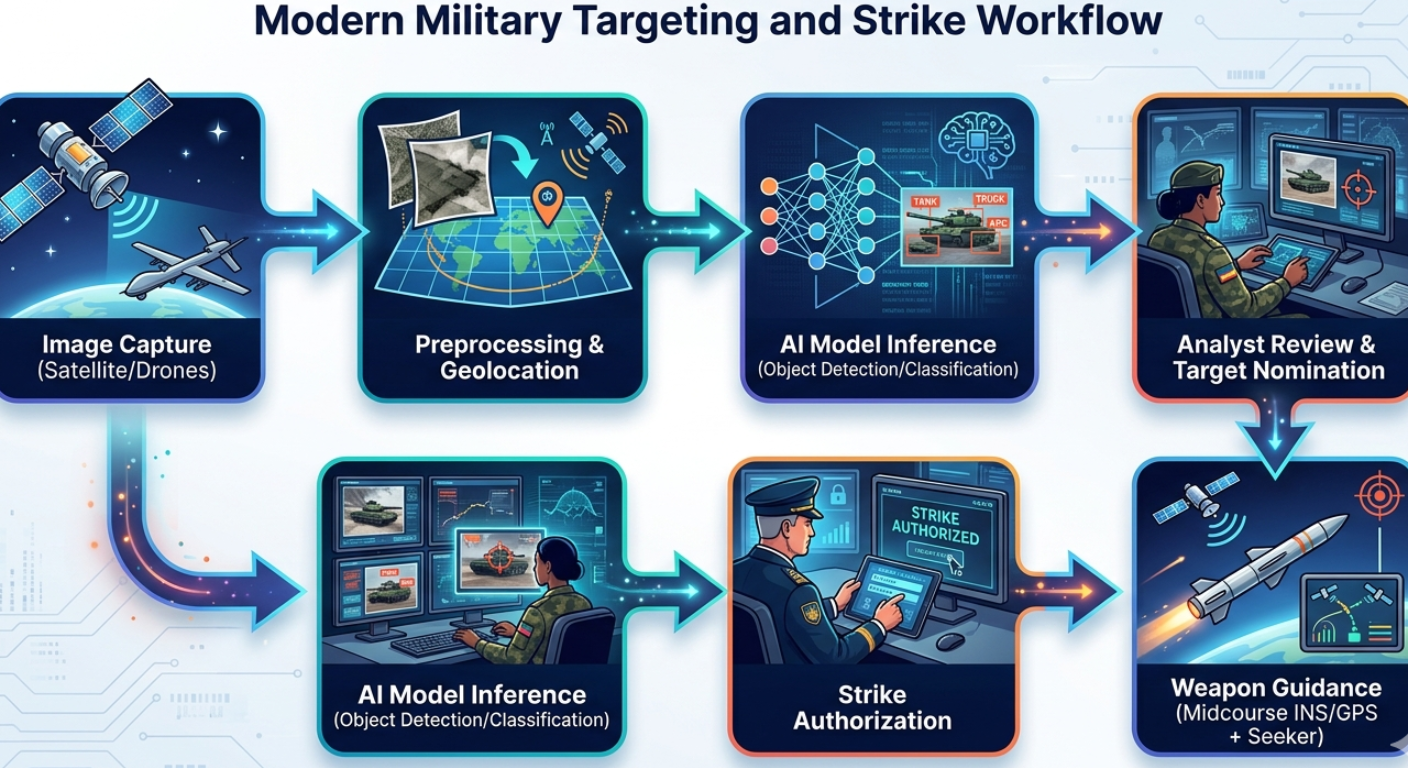
Modern targeting systems often combine multiple sources of information such as:
satellite imagery
signals intelligence
historical intelligence databases
pattern recognition software
If outdated or incorrect data remains in the system, an algorithm could flag the location as a potential target, even if the building is now a civilian structure like a school. This type of error is known in defense technology discussions as a data integrity failure, where the underlying information used by the algorithm is inaccurate.
What AI Technology May Have Been Used
Military analysts often mention AI-supported intelligence tools such as data-analysis platforms and target identification software used by defense agencies. One well-known example used in military intelligence analysis is Project Maven, a system designed to help analyze drone and satellite imagery.
These systems do not directly launch missiles. Instead, they help analysts identify objects, patterns, or locations that might require human review. At this time, no official statement has confirmed exactly which AI system, if any, contributed to the Minab targeting process. However, discussions around AI-assisted targeting have increased because modern defense operations increasingly rely on these tools.
Why the Algorithm Might Have Flagged the Location
There are several possible reasons why a targeting algorithm could highlight a location:
Outdated intelligence data that incorrectly labels a building
Satellite imagery patterns that resemble military infrastructure
Signals data suggesting activity that appears suspicious
Location proximity to known military facilities
If these factors appear together in a dataset, the algorithm might assign a higher probability score to the location being a military target. Human analysts are normally expected to review these signals carefully before approving any strike.
Could This Technology Be Used Again in Future Conflicts?
AI-assisted targeting technology is already widely used in many military operations around the world. Systems that analyze satellite images, drone feeds, and intelligence databases are considered essential tools in modern defense strategy.
Because of this, it is very likely that similar AI-supported analysis systems will continue to be used in future operations.
However, incidents like the Minab tragedy are increasing calls for:
stronger human oversight in AI-assisted targeting
frequent verification of intelligence databases
transparent post-strike investigations
international regulations on AI use in warfare
What Experts Are Now Debating
Following the Minab incident, security experts, policymakers, and technology researchers are discussing several critical issues:
Should AI recommendations be allowed to influence lethal decisions?
How can militaries ensure that civilian locations are never mistakenly flagged as targets?
Should AI targeting systems require independent audits before deployment?
Who is responsible if algorithmic analysis contributes to a fatal mistake?
These debates will likely shape how AI military technologies are developed and regulated in the coming years.
Why the Minab Case Matters for the Future
The Minab tragedy is not just a single event. It represents a broader challenge that the world now faces as artificial intelligence becomes more involved in military decision-making. If governments and technology developers do not create clear safeguards, similar systems could be used again in future conflicts, increasing the risk of unintended civilian casualties. That is why many experts believe the Minab case could become a turning point in the global discussion about AI accountability in warfare.
The Legal Question : Who Is Responsible?
The Accountability Problem
It is very hard to assign responsibility in AI-assisted warfare. Possible responsible parties include:
Military commanders who approve strikes
Analysts who interpret intelligence
Software developers who built the AI
Political leaders who set the mission
AI can make decisions faster than humans, but it also blurs the line of responsibility.
Why the Minab Incident Could Change AI Warfare
More AI in the Battlefield
Armies around the world are using AI and data systems more than ever. The Minab tragedy shows how dangerous it can be when civilian areas are mistaken for military targets.
Calls for Rules and Transparency
Human rights groups are asking for clear rules on AI use in war. They want governments to be open about how AI helps make targeting decisions.
Shaping the Future
This incident could lead to new laws, audits, and international agreements to make sure AI in war does not harm innocent people.
Questions the World Still Needs Answers To
The Minab school tragedy leaves four big questions:
Why was the school flagged as a target?
What is the real number of casualties?
What weapon was used?
Was there a second strike?
As AI becomes a bigger part of warfare, accountability will be the most important issue. Countries, tech developers, and legal experts must work together to prevent such tragedies.
About the Author:
Zeeshan Ahmed is a researcher, blogger, SEO specialist, and Social Media Manager at GlaxIT Software Agency. He holds a Master’s degree in Physics from the International Islamic University, Islamabad, and has been involved in various research works in Nanotechnology and Materials Science. With over three years of experience, he blends his scientific background with SEO expertise to create insightful, research-driven content for the IT sector.
FAQs
1. Who is responsible if an AI-assisted system leads to civilian deaths in war?
A. When an AI system helps identify a target, responsibility usually does not belong to the machine alone. Military commanders approve strikes, intelligence analysts review data, and political leaders set the mission rules. If a deadly mistake happens, investigators often examine the entire decision chain to determine whether humans relied too heavily on algorithmic recommendations without proper verification.
2. Is the “human-in-the-loop” really effective in AI-based targeting decisions?
A. In theory, the human-in-the-loop model means a human must review and approve every strike recommendation made by an algorithm. However, critics argue that when systems process targets at extremely high speed, humans may only perform a quick check rather than a deep investigation. This raises concerns that human oversight may become symbolic instead of meaningful.
3. Why do experts question the use of private AI tools in military targeting systems?
A. Technology companies sometimes develop AI models that can analyze large datasets quickly. When governments use such tools in military environments, critics ask whether these systems were designed or tested for life-and-death decisions. Concerns often focus on transparency, ethical responsibility, and whether commercial AI systems can safely support complex military operations.
4. Why is accurate military data so important in AI-driven targeting?
A. AI systems rely heavily on existing databases and maps to identify potential targets. If the underlying data is outdated or incorrect such as a building being labeled incorrectly years earlier—the algorithm may repeat that mistake. This is why experts stress that data quality and regular verification are critical when AI tools are used in military decision-making.